
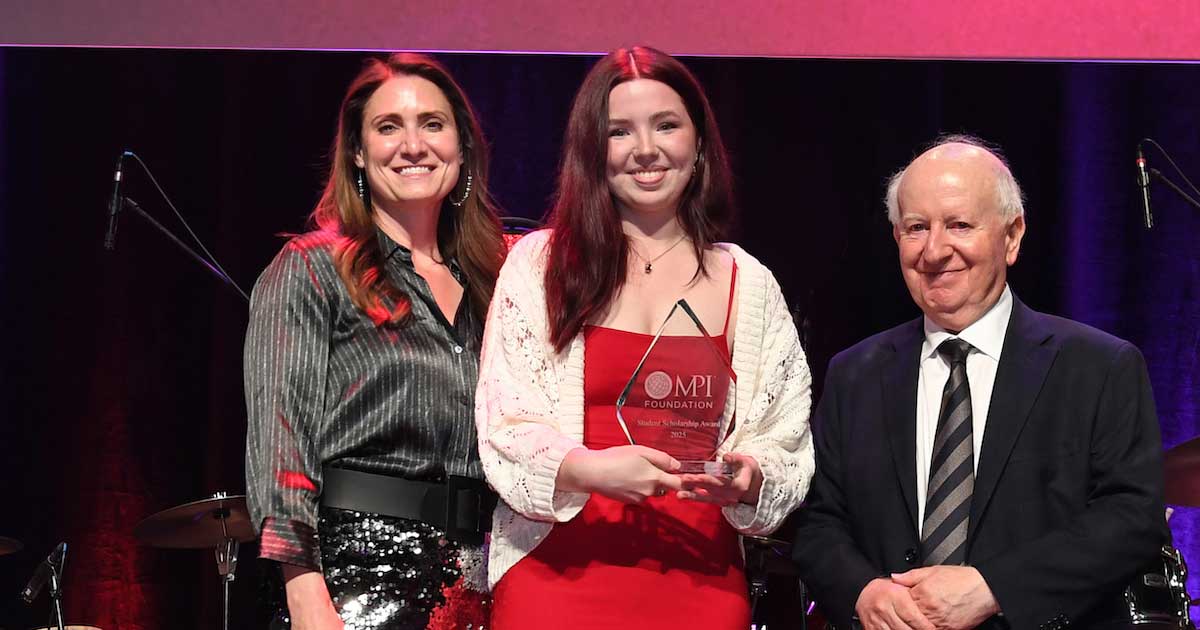
Viktoriia Yushkaliuk (MPI Poland Chapter) was born and raised in Ukraine, and the ongoing war has had a direct and personal impact on her.
"I’ve seen how it has affected soldiers and their families—how it changes their daily lives, routines and even their personalities," she says. "My own family members are currently serving on the front lines, including my uncle. He, his wife and their children are constantly in my thoughts."
Yushkaliuk’s "Mental Health & War: Healing the Invisible Wounds" project, which won the Future Leaders Forum (FLF) University Challenge at IMEX Frankfurt earlier this year, was dedicated to her uncle and his family and detailed a potential conference that would address "the psychological impact of war on soldiers, veterans and civilians by providing a platform for expert discussions, innovative therapies and long-term mental health solutions" while also meeting key United Nations Sustainable Development Goals.
The FLF is run in partnership with IMEX, MPI and MCI. University Challenge finalists are able to attend IMEX Frankfurt thanks to scholarships from the MPI Foundation—and as a result of winning the challenge, Yushkaliuk will also have the opportunity to attend either MPI’s World Education Congress or European Meetings & Events Conference in 2026, courtesy of the MPI Foundation.
"Very few of us wrestle with these daily discussions regarding war and terror," shared Kevin Kirby, executive director of the MPI Foundation. "The intent of the FLF University Challenge is to recognize talent and enhance opportunities of workforce development in our industry. To have a concept so raw and so applicable presented in a comprehensive manner, makes you feel proud of the future of our industry."
Yushkaliuk, a junior project manager at MeetingPlanner.pl, says the idea came to her after a conversation with her uncle—"a regular day, nothing special on the surface."
"But when we talked, I felt the weight of what he was carrying, emotionally and mentally," she says. "That’s when I knew if I was going to participate in the University Challenge, this had to be the topic. I wanted to speak about something close to my heart, something painfully real—about Ukraine and the invisible wounds that so many carry long after the fighting ends."
The most difficult part of her project was translating such an emotionally heavy topic into a clear, strategic event format.
"It’s not easy to design a space for people who have survived war to and talk about what they’ve been through," Yushkaliuk says. "It was essential to create a concept where they would feel safe, seen and not judged."
While bringing such a project to life in Ukraine simply isn’t possible at the moment due to the ongoing war, Yushkaliuk’s dream is to bring something like it to fruition once peace returns for "the brave people who’ve been protecting our country and our independence."
"Winning the University Challenge gave me visibility, but more than that, it gave my message visibility," she says. "It helped bring global attention to a massive that affects millions of Ukrainians."