
Much of learning in today’s meeting industry is very surface level, with presenters lecturing attendees instead of engaging them in a hands-on manner, according to Mitch Mitchem, CEO of HIVE Interactive, a human engagement company that offers AI learning workshops; human skills training like presentation skills, communication, etc., entertainment; and custom research with training projects.
“Our industry can do better by refocusing on those deeper experiential components of learning,” says Mitchem, who led the C-Suite Summit at MPI’s World Education Congress (WEC) in Louisville, Ky., in May with his program, “The New Paradigm of Leadership and Human-AI Teams.” “Since COVID, we’ve gotten away from the experience part of learning, where attendees are applying practical, in-the-moment things in the room but doing so with vibrancy and energy. A human being will learn faster and better and retain more If there’s a component of immediate application, if there’s a component of relevance. That’s the way we design all of our training.”

A key to ensuring relevance is having those who deliver and design training understand the biggest issues the audience is facing, from AI tools integration and communication to leadership, presentation skills and even collaboration.
“I’ve seen presentation skills courses where they instruct you to get up and talk about your pets,” Mitchem says. “But how is that relevant to you presenting in front of your board or in front of your leadership? So let’s focus on a relevant presentation that you’re afraid to deliver that has a lot of high stakes in it. Because then we’re dealing with something that you’re immediately going to want to learn because it applies.”
Mitchem would like to see events include boot camps such as “How Do You Present Your Ideas to Your Clients?”
“That’s the way a lot of training was done leading up to COVID; you were going to be in the room talking about real things,” he says. “I think COVID sort of put up barriers between humans. Now it feels like a Zoom call even if a person is presenting in front of the room. The engagement factor is gone now, and we need it back desperately.”
HIVE facilitators always start their sessions with music, energy and engagement to set the right tone.
“This was normal forever in training—there was music, there was interactivity, there was this vibe going,” Mitchem says. “I’ve been to multiple conferences around learning lately and I haven’t seen any other facilitators doing that. That’s surprising because it breaks down walls and gets us relaxing, which is how we’re going to learn more. We need to go back to the fundamentals of learning: fun, engagement, excitement and practicality.”
It’s also tremendously important for facilitators to seem approachable.
“Always talk as if you’re talking to one person, not to a group,” Mitchem says. “If I speak to a group of a 1,000 people, I always talk like there’s just me and one other person in the room. That way, they’re going to get all of me instead of a talking head that then becomes something else when I walk off stage. Teaching, facilitating and training should be authentic.”
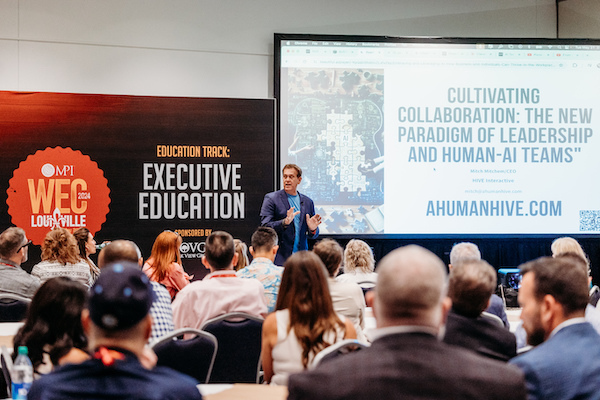
Training: The human element
Mitchem, who is based in Denver, started out in entertainment, going to Chicago in his 20s and building an interactive audience show called Comedy You Can Dance To and studying at The Second City moving into learning and development.
“I worked with a learning and development company for years, and I learned how to build training, how to facilitate it. I learned leadership development and became an executive with that company,” he says. “I learned the ins and outs of how entertainment could be layered on top of training. Training didn't have to be this horrible experience. It could be very engaging and still be really powerful.”
After he was recruited to go into the startup world, Mitchem eventually collaborated on the creation of a dating app that he sold after it reached 300,000 users.
“That was really a huge learning around how algorithmic things affect us as humans inside technology” he says. “After COVID hit, I had built a new training company and I was like, ‘You know, I think I’m going to merge some things together,’ because I identified coming out of COVID that we were all as human beings kind of in trouble from the standpoint of being human. We had lost our connections. We had lost our authentic selves, our ability to meet and communicate and engage with each other. The event industry saw probably the worst of a lot of industries—just the pulverizing of that connection.”
Thus, HIVE Interactive was born.
“The goal was designing everything we do—entertainment, training, learning, speaking, etc.—for the human component, the human element,” Mitchem says.
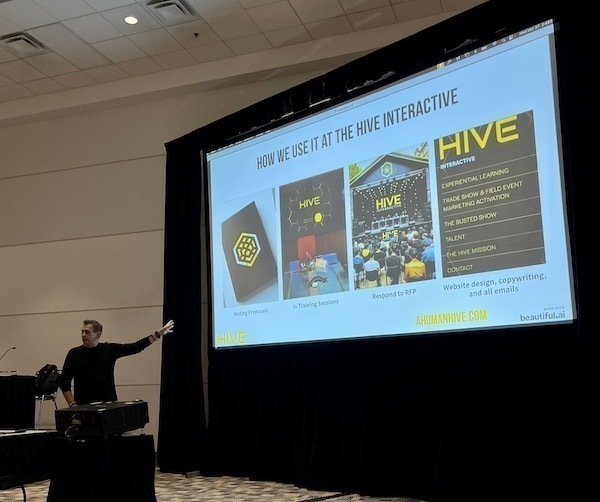
AI: A shift in thinking
One of HIVE’s experiential learning programs, AI Titan, involves participants building a company using AI.
“So you’re learning the tools of AI while you’re building this fictitious company, and then you have to present it,” Mitchem says. “Then we have discussions. Were you ethical about it? How were you using it? What were your prompts? We’re helping them understand this new technology, this tool that can augment them in their business. This is probably our biggest offering in the learning space: workshops about AI and the human element.”
For WEC C-Suite Summit attendees, Mitchem didn’t want to approach AI from a 30,000-foot view, but rather get into the details of how it actually works and how you they could use it.
“I taught the leaders that you have to treat AI not like a search, but more like an employee, like a person,” he says. “That fundamental shift in your thinking will change the way you address it. So instead of saying, ‘Find me this, this and this,’ which is a very searchable kind of mindset, you say, ‘OK, let’s collaborate; I need help with an agenda for my conference—we’re going to be in this city, I need some restaurant suggestions.’”
Mitchem did warn C-Suite Summit attendees that if they struggle with delegation or giving clear instruction to humans, they will also struggle at first with AI.
“We’ve learned this not only in the research we’ve done but in the programs we’ve delivered: If you actually use AI more and more on the large language model side, like ChatGPT or Gemini, what will happen is your skills in being able to give instruction to people will improve because you will realize how sometimes you’re clear and sometimes you’re not,” he says. “It will actually train you while it’s delivering. That’s not a tool that’s ever existed in our culture—something that I’m using every day and while I’m using it, I’m also getting smarter. And we are very immersed in it. I encourage the team to shortcut and use it as much as they can because it will enhance them, not take away from what makes them special.”