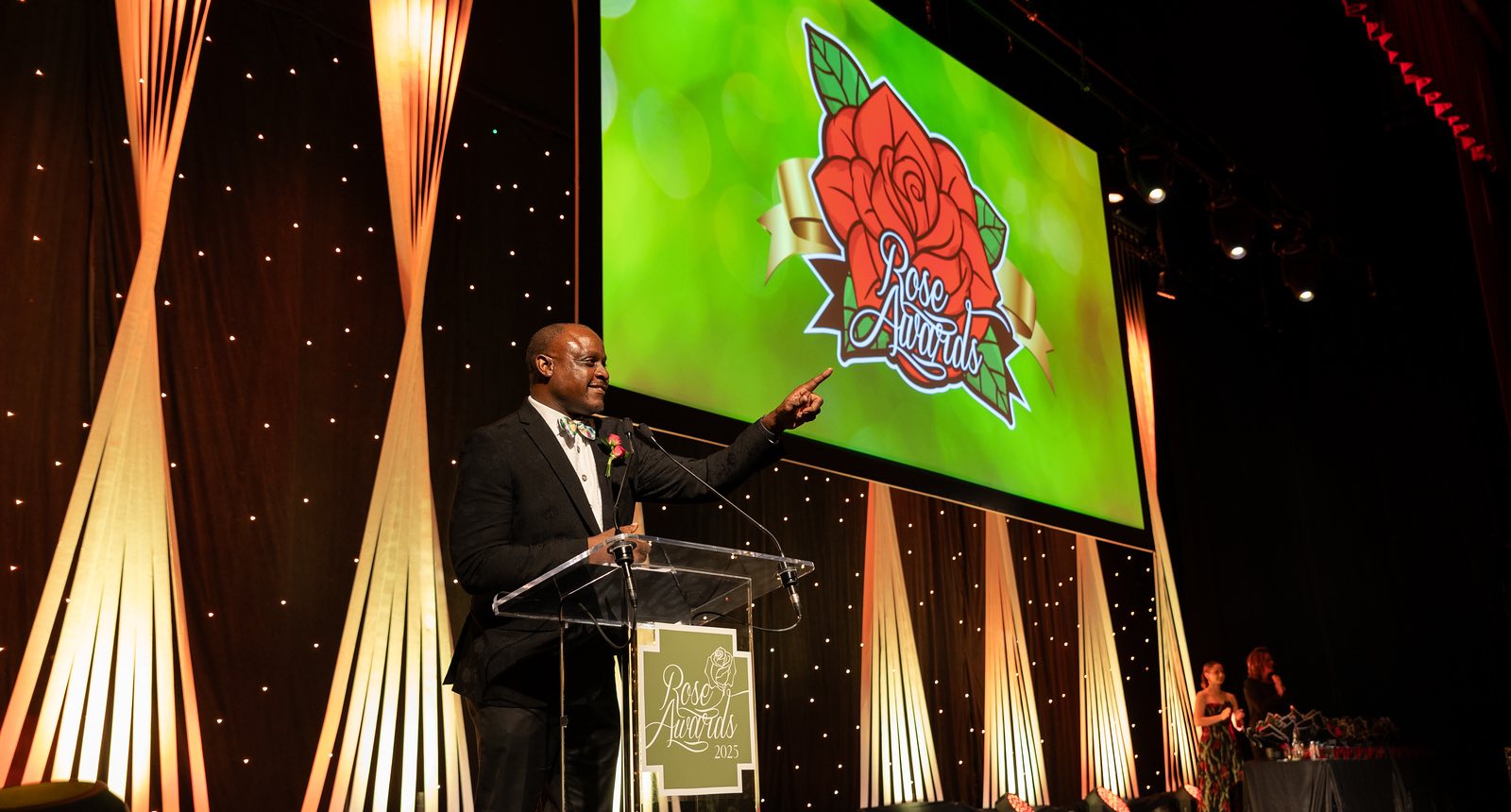

A couple of pivotal moments in Devon Montgomery Pasha's career involved connecting with the MPI community at just the right time. First was learning about event design through Global Meetings Industry Day. The next was being asked by Courtney Stanley to be the opening keynote for the She Means Business track at IMEX America for Smart Monday, powered by MPI.
"‘Owning Your Scarlet Letter,’" my very first keynote, is one that I’m very proud of, and I don’t think I’ll ever forget that day, or the people in the room," says Pasha, CMP, CED (MPI Texas Hill Country Chapter), a professional emcee, facilitator, event designer and experience engineer. "I was proud of the impact that I made."
A couple of pivotal moments in Devon Montgomery Pasha's career involved connecting with the MPI community at just the right time. First was learning about event design through Global Meetings Industry Day. The next was being asked by Courtney Stanley to be the opening keynote for the She Means Business track at IMEX America for Smart Monday, powered by MPI.
"‘Owning Your Scarlet Letter,’" my very first keynote, is one that I’m very proud of, and I don’t think I’ll ever forget that day, or the people in the room," says Pasha, CMP, CED (MPI Texas Hill Country Chapter), a professional emcee, facilitator, event designer and experience engineer. "I was proud of the impact that I made."
My maternal grandmother, Hilda Gorena, was a home economics teacher and homemaker. She made being a homemaker look like more than the sum of its parts. It’s an art and a skill. But what was underneath it was this sense of hospitality. It was how people felt when they were in her house. She was creating these welcoming spaces where they belonged, where they felt at home. You could see the reaction from people when you were offering them that sense of hospitality. I didn’t realize it at the time, but that had a massive impact on me.
My paternal grandmother, Dr. Martha Montgomery, was more of an academic and socialite. She was a very educated woman who had a gorgeous townhouse in Philadelphia near Drexel University, where she was a vice president in the 1990s. She loved to gather people together to see what happened. Her colleagues shared with me that she would put people in a petri dish, and if she could combine knowledge from various people, what would that spark? What could that do for the world? And she was really big on women’s education. She went to Bryn Mawr College, a woman’s college outside of Philadelphia, and I followed in her footsteps. I also like getting people together and creating experiences where they can be their best selves. My joy is when I feel like I’ve done that well and people leave being affected emotionally.
Why did becoming a Certified Event Designer (CED) become a priority for you?
The CED felt like me. I had a lovely virtual discussion with a gentleman named Anthony Vade, who poured me this Kool-Aid about event design, and just like that I was completely hooked. It was like someone had given me a whole new language to speak about work that I was already very passionate about. I became passionate about this concept of design thinking, learning more about experience journeys and about empathy-based systems. Getting my CED designation was the catalyst to taking all this knowledge and passion and turning it into something that the industry had named and recognized.
What role has event design advancement and education of others played in your career?
One of the things I love the most about event design is empathy. Empathy has gotten a bad rap as being a "soft skill"—not being viewed as important as hard skills. Empathy is my superpower and event design gave me the ability to hone that superpower and then to use it to design experiences that taught others. The role of event design in my career advancement, the role of design in educating others, allowed me to highlight how important empathy is as a skill in any job, in any industry. That’s what I got to teach my students at Drexel University, too: You’re going to have events in your life regardless of what industry you choose. Understanding how to design them for success is going to be a skill like cooking: an essential life skill. I was able to push beyond my own boundaries and start using critical thinking and my gifts for facilitation, speaking and education to design courses, classes and conversations to help educate the industry for the past few years about event design. I also used it to design my life towards where it is now, being a solopreneur.
Do you have a tip for meeting pros wanting to improve the design of their events to get better results?
Ask a lot of questions and don’t fall in love with the first answer. Historically, meeting pros default to engineering thinking: there’s a problem and one solution. We don’t stop to think about how many possible solutions there are and how different solutions can benefit stakeholders differently. Think about this: Who are your key event stakeholders? Where are they now and where do you want them to be when the event is over? When I design a course for undergraduates, it’s different than when I design a course for adults because they’re coming from different places. So, for meeting pros, are you just going off what happened last year? Are you asking enough questions? How well do you know your stakeholders? Look at what success looks like for each of them and then how to get them from where they are to where they need to be.
Two big trends you’re passionate about right now are values-driven behavior and cultivating a sense of belonging. Can you tell us why these matter to you and how they intersect with event design?
Values drive behavior. So, if great event design is about creating desired behavioral change, what is most likely to change that behavior? Understand values. I have spent a lot of time reading and listening to David Allison (founder of the Valuegraphics Project) and learned that people are very bound to do things based on their value systems. If we can understand values, it helps us move away from demographics—advanced stereotyping—and toward valuegraphics that allows us to really understand what makes a person and how to connect with them.
What’s the No. 1 value? Belonging. I’ve been honored to be a part of "The Belonging Playbook" by Storycraft Lab. The concept of belonging helps us move away from the idea that everyone wants to fit in. Fitting in is not the goal; belonging is the goal. Belonging is being welcome and valued at the event just as you are. I’ve been trying to fit in my whole life. I’m a 6-foot-1, curvy, curly-haired girl, and I literally don’t fit in anywhere—but I belong to my event industry. I belong to my colleagues. I belong to MPI. I am valued as my individual self with all my flaws and skills. I don’t have to change to be validated and have value.
What are you passionate about outside of your career?
That’s a hard question because I feel like I am
my career, and I don’t mean that in a bad way. I’m passionate about
making sure that I am the best and most authentic and healthiest person I
can be. I’m passionate about advocating for myself. I’m passionate
about keeping myself healthy. I’m passionate about mental health. I’m
passionate about helping others. Oftentimes, I meet students or young
people in our industry, predominantly young women, who say, "I don’t
know what to do" or "This is really hard, can I have 30 minutes of your
time?" And I’m like, "Yeah, take an hour. Let’s have some coffee,
whether in person or on Zoom." Sometimes you just need a little pep
talk. That always really pumps me up because I can save someone the sort
of mental and emotional anguish that I had to go through to get to
where I am.