

Lifted by several years of exponential growth, the meeting and event industry continues to push forth like an unstoppable bullet train, but against a backdrop of concerning international conflicts and economies teasing recession. One thing is clear: a landscape of super growth has its challenges.
Within MPI’s Q3 2024 Meetings Outlook survey were several unique questions to help paint a picture of some financial realities being encountered by event professionals. In doing so, the data revealed general similarities in what planners and suppliers are experiencing, as well as elements of contrast.
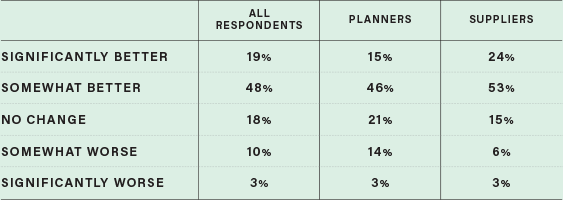
A solid majority (67%) of all respondents identified their business unit’s overall financial health as better, compared to the same time last year. Only 13% said it had gotten worse year over year.
Hinting at a business landscape in which more respondents are experiencing a market that still favors sellers, planners are less likely to identify their businesses as financially healthier than they were a year ago. Specifically, 61% of planners and 77% of suppliers cited a trend of greater financial health. Accordingly, on the flipside, 17% of planners and 9% of suppliers said the opposite—that their business units are currently in worse financial condition.
The extent to which the financial health of event businesses has changed underscores that suppliers are, overall, enjoying better conditions with a majority (53%) reporting "somewhat better" financial health, year over year, and nearly one-quarter (24%) boasting "significantly better" finances.
How is your business unit’s overall financial health trending, year over year?
…AND WHAT OF MARGINS?
While overall financial health provides one view of the strength of meeting and event industry businesses, there’s another related aspect that’s more indicative of growth and can shine a light on the impact of across-the-board cost increases as well as the concern that some suppliers are taking advantage of market conditions and raising prices excessively, beyond simply maintaining profits.
It’s worth remembering that even though the demand for events has grown sharply in recent years and continues to remain strong, many event suppliers also service a leisure market that, especially over the last year, has tickled or surpassed record levels in locations worldwide and escalated the need for serious discussions on combatting overtourism. In short, group business has been contending with strong competition from the leisure travel segment, which has driven up demand and rates.
Now, back to this data. When it comes to profit margin shifts, year over year, just under half (47%) of planners reported increases, whereas more than two-thirds (70%) of suppliers said the same. In fact, a majority of suppliers (54%) reported profit margin growth of up to 15%, a level of growth reported by only 38% of planners.
On the shrinking margins side, one-quarter of planners reported a diminished profit ratio over the last year—mostly down a small amount, by 5% or less. In contrast, only 15% of suppliers reported negative changes to their margins. Notably, no respondents—planners or suppliers—indicated a profit margin drop greater than 25%.
How are your profit margins trending, year over year?
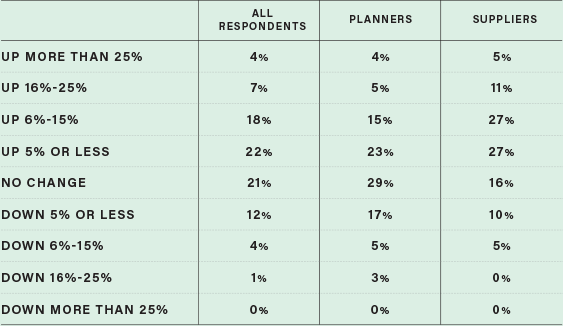
So, that’s the up and down, but what about respondents who just keep on trucking while maintaining their existing margins? In that category, planner respondents were almost twice as likely as suppliers to report no change in profit margins, year over year.
For greater insight into event industry trends identified in MPI’s signature quarterly research, download the Q3 2024 Meetings Outlook report.