
Change isn't new to the travel landscape. Technological innovation, generational preferences, governmental regulations or myriad other causes constantly keep travelers and travel workers alike on their toes. However, the industry has been challenged with extremes in the past few years as both leisure and business travelers bounced back from pandemic-induced wanderlust, seemingly pushing the capacity of air travel to its limits.
But to what extent have travel habits and preferences changed within the meeting and event professional community since 2019? MPI’s Q3 2024 Meetings Outlook survey asked these questions and got some interesting answers.
Appetite is up; satisfaction is down
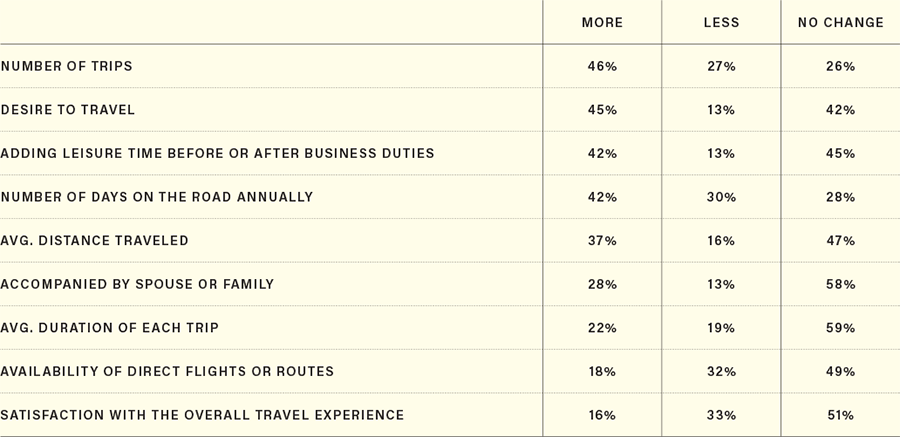
Most significantly, 45% of respondents have more of a desire to travel now than five years ago, while only 13% of respondents have less of a desire to travel.
Seemingly, meeting and event professionals are fulfilling that desire to travel as nearly half (46%) of respondents report traveling more than they were immediately prior to the pandemic. Not surprisingly, 42% of respondents are spending more days "on the road" than in 2019.
Notably, 42% of respondents are embracing the "bleisure" trend by adding leisure time before or after their business responsibilities while traveling. Only 13% of respondents cite less pairing of business and leisure travel.
Subjectively, the worst-performing categories included in the survey were satisfaction with the overall travel experience and the availability of direct flights or routes. While approximately half of respondents noted no change for those two aspects of travel, they were twice as likely to report being less satisfied than more satisfied with the modern travel experience. That ratio was similar for availability of direct flights, with nearly twice as many respondents noting less availability, compared to those encountering greater direct flight options.
For many of these aspects of business travel, habit changes are fairly consistent between planners and suppliers. For instance, 46% of planners and 47% of suppliers are taking more business trips now, compared to 2019. There are, however, a few exceptions where the shifts are notably different between planners and suppliers.
How is business travel different for you today compared to 2019?
Planners are 400% more likely to report an increase, rather than a decrease, in the average distance they travel. Suppliers, on the other hand, are only 37% more likely to report an increase, rather than a decrease, in the average distance they travel.
A greater percentage of planners report an increase in bringing along a spouse or family member during business trips. Responding planners are 25% more likely than suppliers to frequently have family along for the ride.
While the percentage of planners and suppliers reporting a greater satisfaction with the overall travel experience is minimal (16% and 17%, respectively), suppliers are more likely to cite an increased desire to travel (52%, compared to 40% with planners).
Respondents who reported taking more business trips commonly explained the reasoning as due to more or different business that simply requires that travel. But what of those event professionals traveling less?
Lindsay Grosz, CMP (MPI San Diego Chapter), president of Lindsay Grosz Events, reported taking fewer business trips with an average shorter duration and a shorter distance than five years ago. The changed travel habits of some of her clients are a significant cause for the shift in her own travel habits.
"I do notice more conservative approaches from many of my clients regarding the ‘need’ to travel," Grosz says. "As I mainly work within the incentive industry, I’ve found that multiple clubs have been consolidated into one, therefore not having as many trips compared to 2019."
But her own personal goals play an important role in how her travel habits have changed.
"I’m trying to find a healthy balance between work/family life," she says. "I can’t help but experience ‘mom guilt’ when I’m on a work trip and am away from my son and husband for longer periods of time. So, I’ll do anything to shorten the travel and cram in more meetings within a day, take a red eye, etc., so I can get back home."
One way in which she’s been able to spend quality time with family within the context of her business travel schedule has been by adding leisure time before or after business duties while afar.
"Personally, I think ‘bleisure’ is a way meeting planners find balance," she says. "I like having my family see the destinations I get to experience and creating new memories with them while also encouraging their love to travel. However, this has always been important to me—that mentality hasn’t changed much since 2019."
She’s also seeing more incentive and conference attendees leverage this opportunity, whether that’s bringing family along for the programmed dates or extending their time for some true leisure while they’re already at a new destination.
"Professionally, I love seeing attendees experience the destinations I’ve selected for their trips and extending their time to explore further," she says. "When they look back at their time in the destination, they are considering the trip as a whole and not just the business portion, which, in turn, leads to a stronger ROI for my clients."

Embrace the no-fly zone
Mary Anne Whittle, CMP (MPI Arizona Sunbelt Chapter), operations manager at Arizona Farm Bureau, is also traveling less now than in 2019, notably due to rising costs.
"Inflation rates for travel costs, sleeping rooms and meeting costs in general have been the catalyst to review each and every program we produce and either reimagine them or cancel them altogether," Whittle says.
Yet, the greatest change in her travel habits relates to the mode rather than the frequency.
"It is daunting to think about flying anywhere because it is more likely to be an ordeal than not," she said in her survey response recorded prior to the mid-July CrowdStrike fiasco that led to a chaotic week with thousands of cancelled flights and countless stranded passengers globally.
Delayed and cancelled flights, some of which Whittle says span days, combined with overworked airline staff that seem less willing to help, have driven her to, well…drive rather than fly whenever possible.
"I need to be able to count on getting to my destination and I don’t have the confidence with the airlines to reliably get me where I need to go," she explained in a follow-up discussion after the CrowdStrike calamity. "I have had flights cancelled and rebooked for the next day without options and experienced significant delays due to lack of flight crews, and it isn’t worth the stress if I can reliably get to where I need to go via car. As a planner, I have to be at the sites before my stakeholders and delegates— and there have been times when flight issues have prevented that.
"Leaving people stranded with few options, treating passengers as problems versus paying customers, treating delays as a normal occurrence rather than the occasional situation—that’s all unacceptable. If I delivered my meetings and treated delegates the way the airlines [treat] passengers, I would be fired."
This choice hasn’t been without impacts on her planning, schedules and business.
"The biggest impacts have been mostly the extra travel time I have to build in, such as leaving a day or two earlier than I used to in order to ensure I make it to my destination when I need to be there," Whittle says. "Additionally, I am hesitant to pursue professional opportunities that require significant air travel. I just don’t want to deal with the challenges of [air] travel."
De-stressing air travel
While Whittle has given up on most air travel due to the constant, worsening complications, sometimes air travel is absolutely necessary. Here are three of the strategies she’s implemented for those instances.
- "I schedule departures at least one day before I need to be at my destination. This has saved me when flights were cancelled."
- "I create a backup plan for travel by scoping out alternative flights on other airlines should I need to make changes on the fly due to delays or cancellation. That way, I can quickly make other arrangements should the airline I am booked on [be unable to] accommodate my timelines."
- "I always arrive at the airport at least two hours before my flight—no matter where I am traveling."