
Event success is too often measured by the quantity of content delivered rather than by the quality of the experience created, according to Giuseppina Cardinale.
“While packed agendas may appear efficient, they often leave participants overwhelmed, fatigued and with limited space to reflect or connect,” says Cardinale (MPI Italia Chapter), key account director for Starhotels. “What truly matters is creating the conditions that allow people to absorb information, reflect on new ideas and build meaningful connections with others. In an age where we are constantly exposed to information, attention has become one of our most valuable resources.”
Small moments can make a remarkable difference for attendee wellness, Cardinale says, such as a walk between sessions, a few minutes of movement, a mindful coffee break or simply time for informal conversations.
“These pauses are not empty spaces in the agenda; they are often where ideas are consolidated, relationships are formed and creativity emerges,” she says.
While we have made significant progress in recent years, there is still room for improvement for wellness at events, according to Cardinale.
“More event organizers are now recognizing that attendee well-being directly influences engagement, learning and overall satisfaction,” she says. “As a result, we are seeing more intentional breaks, outdoor activities, healthier food options, movement sessions and greater attention to the energy flow of the day.”
The future of successful events, according to Cardinale, will be found in a human-centered approach to design that respects natural rhythms by balancing focus, interaction, inspiration and recovery.
“When we acknowledge that people are not machines but individuals with physical, mental, emotional and social needs, we create experiences that are not only more enjoyable but also more effective,” she says.

Breathing room
Part of what hinders our event wellness improvement is equating value with density, according to Heather Dow, CPhT, CAE, CPC(HC), senior manager for Events & Management Plus Inc., a member of the MPI Foundation Global Board of Trustees and chair of the MPI Canada Council.
“We schedule more sessions, more keynotes, more networking, more social activities and assume that more exposure creates greater impact. The evidence suggests otherwise,” she says. “Learning retention improves when content is delivered in manageable doses over time, with opportunities for reflection and application. The same principle applies at conferences.”
Dow challenges event pros to think about the difference between rigorous and onerous.
“Rigorous programming is intentional, progressive and outcome driven. Onerous programming simply fills time,” she says. “Some of the most meaningful learning at conferences happens in conversations over coffee, walking between sessions or connecting ideas with peers. Those connection-driven learning moments allow attendees to integrate ideas through reflection, discussion and shared experience.”
Creating space for reflection, movement and organic connection does not reduce impact, but rather increases it, according to Dow.
“People rarely leave conferences saying, ‘I wish there had been one more slide deck,’” she says. “They remember the conversation that changed how they think.”
Jennifer Lucio Vargas, CMP (MPI South Florida Chapter), founder, president and CEO of 305 Communications and Events, says over-programming our events is coming at the expense of the attendee experience.
“The best thing we can focus on is having intentional pauses without compromising the schedule—things like quiet spaces or speakers articulating to the audience that it is OK to walk away if they need to,” she says. “We have to normalize that not every moment during an event is meant to be ‘on.’ We can start by thinking about designing our events with energy and experience in mind, not just content.”
While we’re doing better than we used to when it comes to integrating well-being into events, there’s still room to grow, according to Rachel Benedick, chief revenue officer for MPI and an advisor to the Global Wellness Initiative’s (GWI) Meetings and Events Initiative.
“A lot of it comes down to how we evaluate the success of an event,” she says. “If the only metric is, ‘How many leads did I get, and how fast?’ we unintentionally design experiences that are nonstop, transactional and exhausting. That pace leaves very little room for the moments that build long‑term business: connection, reflection and relationship‑building.”
To truly balance high‑impact programming with opportunities to recharge, according to Benedick, we must normalize downtime and rethink pacing.
“When attendees are scheduled from sunrise to well past sunset, their tanks empty quickly,” she says. “But when we intentionally create space—for conversation, for quiet, for serendipity—we give people the capacity to engage more meaningfully. The first meeting may not produce business, but the third or fourth might, and you only get there if the environment supports sustained human connection.”
Benedick says while business outcomes are still critical, the path to those outcomes is more nuanced than some realize.
“The better we get at honoring both impact and restoration, the stronger our events will become,” she says.
Road-tested resilience
Maintaining your personal wellness on the road takes intention, but it’s achievable with planning and consistency, according to Benedick.
“For me, exercise is my happy place—I’m better in every aspect of my life when I’ve moved my body—so I prioritize it no matter where I am,” she says. “I look for hotels with 24‑hour gyms because I’m an early‑morning workout person. I pack my gear, I set the alarm and I don’t negotiate with myself. I get up and get it done.”
Hydration is also critically important to Benedick, who says that while drinking water becomes second nature when you live in a climate like Denver, travel certainly disrupts routines.
“I make it a priority and even gamify it a bit to stay on track,” she says. “Eating well on the road can be tricky, but I focus on making the best choices I can. A few imperfect meals won’t derail you—but months of not fueling your brain and body definitely will.”
Abstaining from drinking alcohol when traveling for work is important for Benedick because the days are long, the schedules are intense and skipping the glass of wine makes it much easier to sleep and get the morning workout in.
“And because mental rest is just as important, I always travel with a book,” she says. “It gives my brain a break at the end of the day or on the plane—a small ritual that helps me reset and stay grounded. Balance is elusive for all of us, especially in this industry, but if you keep prioritizing it, you get better over time. Not every trip will be perfect, but the goal isn’t perfection—it’s progress.”
David T. Stevens, co-founder of Olympian Meeting and chair of the GWI Meetings and Events Initiative, has learned to maintain wellness on the road the hard way.
“I came to this work as an event professional who realized we were building extraordinary experiences on top of exhausted humans—and I was one of those humans,” he says. “Wellness is not about being perfect on the road. That is not realistic. It is about protecting the basics before the industry takes them from you.”
Stevens tries to move every day, even if not a full workout, and prioritizes sleep as much as the schedule allows.
“I’ve missed many a session because they programmed ridiculously,” he says. “I look at menus before I show up starving. I hydrate like it is part of my job, because frankly it is. I also try to create small recovery moments before I need them, not after I am already fried.”
The bigger lesson for Stevens is that wellness is personal, but capacity is professional.
“What works for me may not be what works for someone else,” he says. “It might be movement, quiet, therapy, medication, faith, food, boundaries, time outside or asking for help. What it looks like is personal. Whether it matters is not.”
Stevens says that while event pros often call themselves firefighters or chaos coordinators, firefighters do more than respond to emergencies.
“They train. They recover. They use systems. They protect each other before the emergency,” he says. “If we are going to borrow the crisis metaphor, we need to borrow the preparation too.”
Designing for focus and recovery
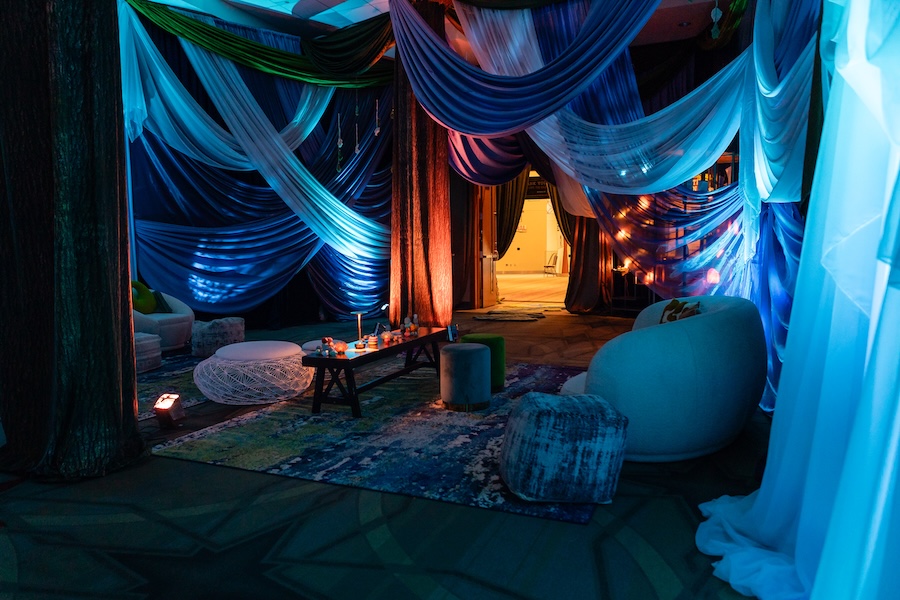
The Resilience Room (or El Claro de Claridad), designed by Hello! Destination Management, was a wellness-focused space at MPI’s 2026 World Education Congress intended to help attendees pause, recharge and regain clarity during a busy conference.
“Using natural elements, calming sensory experiences and principles of Calm Technology, it provided a restorative environment that supported mental well-being and focus,” says Kate Walsh, chief business officer for Hello! Destination Management. “I think it was important because it recognized that attendees need moments of restoration just as much as they need content and networking. My biggest takeaway was that purposeful space design truly influences behavior and experience. When you create an environment that supports wellness and reflection, people return more present, engaged and ready to connect.”
Hello! was awarded the first-ever Calm Tech Institute gold-tier certification for the Resilience Room.
“We hope this certification is simply the first domino in a much larger movement. This isn’t just a conversation about design; it’s a mindset shift toward creating experiences that honor the human need for focus, restoration and connection in an increasingly noisy and overstimulating world,” Walsh says. “If this recognition inspires others to think differently about how they design events and environments, that’s the real success.”
Heavy use of the Resilience Room, particularly in the afternoons and during the latter half of the conference, reinforced an important lesson for Walsh: When we intentionally create environments that support rest and recovery, we’re not taking people away from the event experience, we’re helping them stay engaged in it.
“Once attendees discovered the space, many chose to recharge there between sessions rather than retreating to their hotel rooms or leaving the event altogether,” she says. “Thoughtfully designed spaces for pause and reflection can actually increase participation, extend dwell time and allow attendees to return to sessions and networking opportunities more present, focused and energized.”
Going forward, Walsh says, we can do even better by treating resilience and restoration as core components of event design rather than amenities.
“The attendee experience should include opportunities to reset with the same level of intention that we apply to education, entertainment and networking.”
Embedded wellness
With a change in attendee expectations to have both engaging programming and relaxing open discovery time, the focus is on balancing wellness with high-impact programming, according to Kate Jansen, CMP, director of marketing and sponsorships for the Raleigh (N.C.) Convention Center and Red Hat Amphitheater.
“The meeting and event industry can really tax our wellness physically and mentally,” she says. “Wayfinding and experience expectations may be some of the most cognitively challenging experiences for attendees. Offering signage and know-before-you-go messaging helps provide clarity. Mental and physical wellness can both be achieved by finding ways to foster connection and shared experiences through hydration and nutrition. Also, by offering adequate restorative downtime between event moments and more open time in schedules, attendees can find time to connect deeper with fellow attendees.”
The goal, Jensen says, has shifted from filling each minute of an agenda to maximizing the value of each moment.
“When attendees have the opportunity to recharge, they return more engaged, retain more education and develop stronger relationships that ultimately allow them to leave with a meaningful connection to the event, the destination and/or venue and to each other,” she says.
There are three large downtown venues in Raleigh known as “The Complex”—Raleigh Convention Center, Red Hat Amphitheater and Martin Marietta Center for the Performing Arts—that offer features to make wellness and accessibility a part of every event at no additional programming cost, according to Jensen. Each venue is KultureCity-certified and offers complimentary sensory-inclusive kits to assist neurodiverse visitors with sensory processing needs.
“A subtle moment can be added to the facilities to remind all attendees of their holistic health while attending events,” Jensen says. “Partnering with a local hospital, WakeMed, who is leading in mental health and community wellness, The Complex now has wellness messaging throughout all facility restroom mirrors. This signage encourages attendees to ‘share their smile’ and be aware that attention to mental health can provide exceptional moments. Signage is unique across the venues; some will remind attendees ‘image isn’t everything, but you are’ while others inspires attendees to ‘let the music feed your soul’ or to take a minute for box breathing before that next big conference session with a simple ‘breathe in, breathe out, believe in yourself’ statement.”
WakeMed Hospital experts also offer event programming such as guided meditation and activations to share stories and offer deeper attendee connections while also destigmatizing mental health, according to Jensen.
“Through these types of additions to facilities and partnerships, venues can better help meeting planners start to achieve the wellness goals for their events,” she says. “Exceptional events are built through intentional partnerships that elevate the attendee experience beyond the meeting room. Creating meaningful moments without adding complexity for planners is our key motivation.”