Studying for the Certified Meeting Professional exam? MPI Ottawa has you covered!
Learn More
Check out all the exciting events taking place in the upcoming year!
Learn More

From Literacy to Learning: Why In-Person Meetings Still Matter in a Digital World
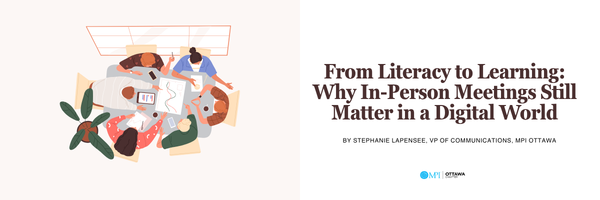
Between September 8 and September 15, the world celebrates two powerful observances: International Literacy Day and Online Learning Day. As someone who's spent decades in the meetings industry, I see these dates not as separate moments, but as a conversation, one that's deeply relevant to everything we do.
And it starts with this question: In a world where anyone can learn anything online, why do we still need to gather in person?
The answer might surprise you.
Beyond Reading: What Modern Literacy Looks Like
International Literacy Day has traditionally focused on the ability to read and write. That still matters profoundly. But the definition of literacy has evolved. Today's literacy includes digital literacy, data literacy, emotional intelligence, and the ability to navigate complex information ecosystems.
You can't get all of that from a screen.
Here's what studies consistently show: while online learning retention rates are higher than traditional classroom instruction (25-60% versus 8-10%), there's a critical gap. Online learning excels at delivering information. In-person and hybrid experiences excel at developing relationships that lead to understanding, behavior change, and innovation.
That's the literacy our industry specializes in.
The Meeting as a Learning Catalyst
Think about the most transformative professional moment in your career. Was it reading an article? Or was it sitting across from someone, in real time, exchanging ideas, building trust, and discovering something neither of you would have found alone?
This is where meetings become indispensable.
When an association brings its members together for an annual conference, they're not just transferring information. They're creating what researchers call "social learning", the ability to absorb new ideas, test assumptions, and build the networks that sustain careers.
When a corporation hosts a strategy session, they're not merely discussing data points. They're building alignment and commitment in a way that a series of video calls cannot replicate.
When a sports organization convenes its leadership, the value isn't in what's said. It's in the relationships forged, the trust established, and the collective commitment to a shared mission.
These experiences create a different kind of literacy: the ability to lead, collaborate, and adapt in real time.
The Hybrid Advantage
Online Learning Day celebrates the democratization of knowledge. And it's real. Digital platforms have removed barriers to learning for millions of people. But here's what we've learned—especially post-pandemic—is that hybrid and in-person experiences aren't competitors to online learning. They're complements.
The most effective modern learning strategies combine both:
Online components deliver foundational knowledge, allow self-paced learning, and increase accessibility for attendees who can't travel.
In-person elements facilitate deep discussion, relationship-building, and the kind of spontaneous collaboration that transforms ideas into action.
Your organization's annual conference isn't competing with LinkedIn Learning. It's offering something entirely different: the chance to connect with peers facing the same challenges, learn from experts in real time, and build the trust that leads to partnerships.
That's the hybrid advantage.
What This Means for Our Industry
As meeting professionals, we have a responsibility, and an opportunity to design experiences that honor both digital and in-person learning.
The questions we should be asking:
How can we create pre-event content that brings attendees up to speed before they arrive, so the time together can focus on dialogue and discovery?
How can we extend the learning beyond the event through online communities, recorded sessions, and follow-up engagement?
How can we be intentional about networking design, creating structured moments for the unplanned conversations that lead to breakthroughs?
How can we measure what matters? Not just attendance, but the relationships formed, the ideas that sparked, the partnerships that launched.
A Practical Challenge
I want to challenge you this month: Look at one of your upcoming events through a learning lens.
What are attendees coming to learn? Not just topics, but what transformation are they seeking? How does your design facilitate that? Are you creating space for the spontaneous conversations where real breakthroughs happen? How will you help attendees retain and apply what they learn?
The answer won't be found in a checklist. It will be found in the relationships you build and the intentionality you bring to designing experiences that matter.
The Bottom Line
International Literacy Day reminds us that the ability to read and learn is foundational. Online Learning Day celebrates how technology has expanded access to knowledge. But meetings do something that neither online nor offline alone can accomplish: they create the conditions for human beings to grow together.
In September, as we mark these two observances, let's appreciate both the information economy and the relationship economy.
Better yet, let's design meetings that honour both.
Because in the end, literacy isn't just about consuming information; it's about the connections we make, the ideas we develop together, and the trust we build that makes transformation possible.
That's what meetings are for.
MPI Ottawa is committed to advancing the meetings industry through education, advocacy, and community. Learn more about how we're designing the future of professional gatherings at [website].
International Literacy Day is celebrated annually on September 8 to highlight the importance of literacy. Online Learning Day, observed on September 15, celebrates how digital education breaks down barriers and expands access to knowledge.
 Article edited by: Darlene Kelly-Stewart, Stonehouse Sales & Marketing Services
.jpeg?sfvrsn=29903855_1 "stephanie-lapensee-(1)")

Leave a commentOrder by
Newest on top Oldest on top