
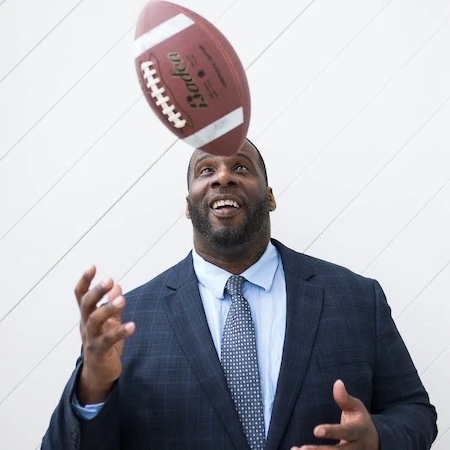
Keynote speaker and former NFL offensive lineman Shawn Harper on making decisions based on purpose, preparation and possibility instead of fear.
During uncertain times, a lot of organizations naturally go into protection mode, according to Shawn Harper, a former NFL offensive lineman, corporate CEO and best-selling author of “The Winning Edge.”
“They stop creating, stop taking smart risks and start making decisions from fear instead of vision,” says Harper, who will be presenting the MPI keynote “The Winner’s Mindset: A Proactive Approach to Business in Uncertain Times,” sponsored by New Orleans & Co. in partnership with Damon Brooks & Associates, on Oct. 13 at IMEX America 2026 in Las Vegas. “That is what I call playing not to lose. You may still be moving, but you are not moving with confidence.”
To break out of it, leaders have to reset the mindset of the team, according to Harper.
“They have to remind people what they are fighting for, not just what they are trying to avoid,” he says. “Playing to win does not mean being reckless. It means being clear, courageous and intentional. It means making decisions based on purpose, preparation and possibility instead of fear.”
Harper, who founded and led a multimillion-dollar security firm for more than two decades, is known as the “Winologist” and helps organizations apply the elite-level strategies of professional athletes to business, leadership, culture and life. We spoke with him about shifting strategies from fear to innovation and thriving in times of uncertainty.
Your career has taken you from the NFL to leading a successful business. What lessons from professional sports have proven most valuable in helping leaders navigate change and disruption?
One of the greatest lessons I learned in professional sports is that the game is always changing, but your preparation cannot. In football, the defense shifts, the crowd gets loud, the momentum changes and sometimes the play breaks down. But winners do not panic. They adjust.
That lesson has helped me as a business leader over and over again. Change is not the enemy. Lack of preparation is. Great leaders know how to stay focused under pressure, communicate clearly, trust their team and make adjustments in real time. In sports and in business, the team that can adapt without losing its identity is the team that wins.

In your session, you emphasize building a culture that replaces fear with innovation. What are some practical ways leaders can create that shift within their teams?
Leaders create that shift by making it safe for people to think, speak and contribute. Innovation dies in environments where people are afraid to be wrong, afraid to ask questions or afraid to challenge the way things have always been done.
Practically, leaders can start by rewarding ideas, not just outcomes. They can invite honest feedback, celebrate learning and stop treating every mistake like failure. Some of the best breakthroughs come from people who felt trusted enough to speak up.
If you want innovation, you have to build trust. When people know they are valued, they stop protecting themselves and start contributing at a higher level.
Resilience is often discussed as an individual trait, but how can leaders build resilience into an entire team or organizational culture?
Resilience becomes part of a culture when people know they are not carrying pressure alone. A resilient team has clear communication, shared standards, strong relationships and a belief that setbacks are not the end of the story.
Leaders build resilience by preparing their people before the pressure hits. You cannot wait until the storm comes to build trust. You build it in the daily habits: how you communicate, how you respond to mistakes, how you celebrate progress and how you remind the team who they are.
A resilient culture does not deny difficulty. It faces it together and says, “We are built for this.”
You’ve led a multimillion-dollar company for more than two decades. Can you share a time when uncertainty forced you to rethink your strategy—and what you learned from that experience?
There have been several seasons in business where uncertainty forced me to rethink how we were operating. Whether it was economic shifts, staffing challenges or changes in client needs, I learned that what worked yesterday will not always carry you into tomorrow.
One of the biggest lessons I learned is that leaders cannot be married to methods. You have to stay committed to the mission, but flexible with the strategy. In those moments, I had to listen more closely, evaluate what was working and make decisions that positioned the company for long-term strength instead of short-term comfort.
Uncertainty taught me that leadership is not about having every answer. It is about having the courage to adjust, communicate and keep moving forward.
What separates teams that thrive during periods of disruption from those that merely survive them?
The teams that survive disruption usually react to it. The teams that thrive are prepared for it. They have clarity, trust and a strong culture before the disruption ever shows up.
Thriving teams know who they are. They know what matters. They communicate quickly, adjust strategically and keep their eyes on the mission. They do not let pressure define them; they let pressure reveal them.
Disruption exposes culture. If the foundation is weak, pressure creates cracks. But if the foundation is strong, pressure can actually become the place where the team discovers another level of strength.
If attendees leave your session with just one actionable idea to help themselves and their teams succeed in uncertain times, what do you hope it will be?
I hope they leave with this: Stop playing not to lose and start leading to win.
That means walking back into their organization and asking, “Where have we allowed fear to make our decisions? Where have we been protecting instead of progressing? Where do we need to get back on offense?”
Uncertain times do not have to weaken a team. They can wake a team up. When leaders choose clarity over fear, courage over comfort and purpose over pressure, they give their people permission to win again.